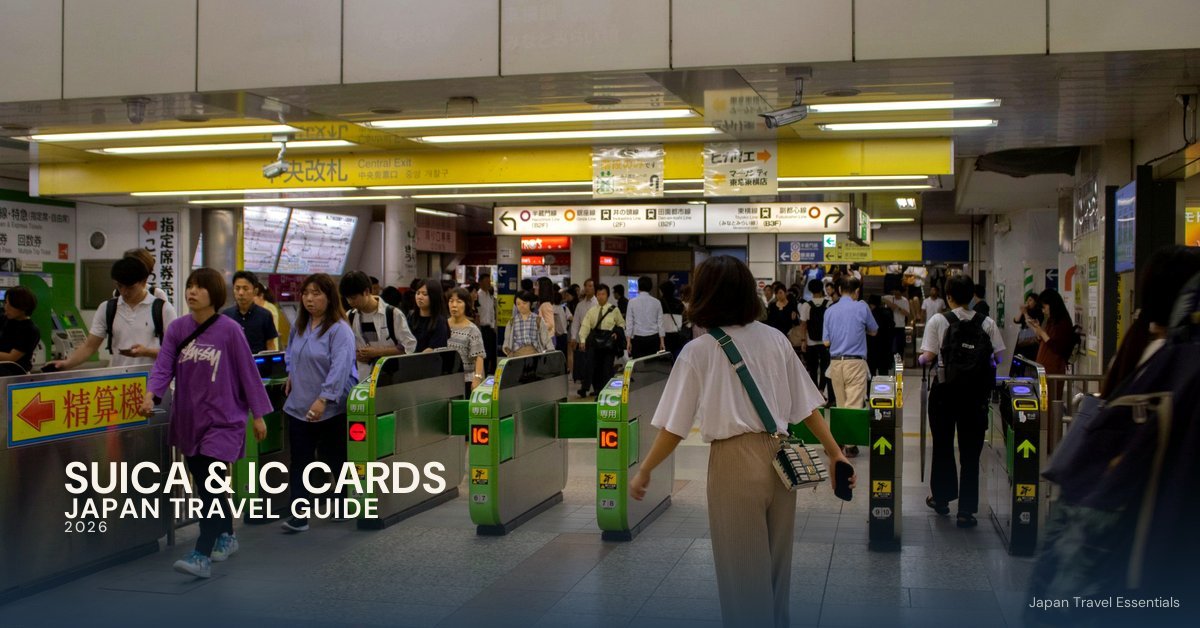
Japan’s IC cards make getting around the country incredibly simple, and for most travelers they are one of the very first things worth setting up after landing. This guide walks you through what an IC card actually is, where to buy one in 2026, how much it costs, and exactly how to use it on trains, buses, and at convenience stores.
What Is an IC Card? Suica vs Pasmo vs Icoca
An IC card is a rechargeable prepaid card that lets you tap in and out of trains and buses instead of buying paper tickets every time. Suica (issued by JR East) and Pasmo (issued by Tokyo’s private railways) work identically and are accepted almost everywhere in the country, including on Icoca’s home turf of Osaka and Kyoto. For a first trip to Japan, it genuinely doesn’t matter which one you pick, since all major IC cards are interchangeable nationwide with only a few rural exceptions.
Where to Buy an IC Card in Japan
Tourists have two main options in 2026: a physical Welcome Suica card or a digital version stored in your smartphone’s wallet app.
Welcome Suica for Tourists
The Welcome Suica is a tourist-focused card sold at JR East ticket machines and travel service centers at airports like Narita and Haneda. Unlike a standard Suica, it doesn’t require a refundable deposit and simply expires after 28 days, which makes it ideal for a short trip.
Mobile Suica on Your Phone
If you have an iPhone, you can add Suica directly to Apple Wallet before you even leave home, then top it up with a credit card. Many Android phones with Osaifu Keitai support work the same way through Google Wallet. This skips the ticket machine line entirely and is the fastest way to start using trains the moment you land.
How Much Does It Cost and How Do You Recharge It?
A physical Suica or Pasmo typically costs a small refundable deposit on top of however much you load onto it, while the Welcome Suica has no deposit at all. You can recharge, or ‘top up’, at any station ticket machine, most convenience stores, and directly through Apple Wallet or Google Wallet if you’re using a mobile card. Cash and most Japan-issued cards work at machines, though not every ticket machine accepts foreign credit cards, so it’s worth carrying some cash for top-ups.
How to Use Your IC Card in Japan
Using the card itself couldn’t be simpler once you know the routine.
Trains and Subways
Tap the card on the reader at the ticket gate when you enter the station, and tap again on the reader at the gate when you exit. The fare is calculated automatically and deducted from your balance, so you never need to work out the correct ticket price in advance.
Buses
On most city buses you tap once when boarding and once when getting off, though on some routes you only tap a single time when you board. A screen near the driver usually shows your remaining balance right after you tap.
Convenience Stores and Vending Machines
Beyond transportation, IC cards double as electronic money at convenience stores like 7-Eleven and Lawson, most vending machines, and many restaurants and shops. Just tap the card on the small reader at checkout the same way you would at a ticket gate.
Suica vs a Physical Card: Which Should Tourists Choose?
For trips of a week or less, the Welcome Suica is usually the easiest choice because there’s no deposit to worry about returning. For longer stays or repeat visits to Japan, Mobile Suica on your phone is worth setting up since it never needs to be physically returned and can be topped up instantly from your hotel room.
What to Do With Your IC Card Before Leaving Japan
If you bought a standard physical Suica or Pasmo with a deposit, you can return it at a staffed ticket window before you fly home to get your deposit and any remaining balance refunded, minus a small handling fee. Welcome Suica cards don’t need to be returned at all since they simply expire on their own.
Frequently Asked Questions
Can I use Suica outside Tokyo?
Yes. Suica works on trains and buses across almost the entire country, including Osaka, Kyoto, Sapporo, and Fukuoka, thanks to a nationwide interoperability agreement between Japan’s transit operators.
What if I lose my card?
A registered Mobile Suica on your phone can be locked or transferred through the app, but an unregistered physical card generally can’t be refunded if lost, so treat it a bit like cash.
Do I get my deposit back?
Only standard physical Suica and Pasmo cards carry a deposit, and yes, it’s refundable at a staffed ticket counter when you return the card.
Can tourists use Mobile Suica without a Japanese phone number?
Yes, Mobile Suica works fine on an internationally purchased iPhone or Android phone with no Japanese phone number required, though you will need a way to top it up, such as an international credit card.
Once you’ve got your IC card sorted, the other piece of the puzzle is staying connected while you’re out exploring. In our next guide, we’ll compare eSIMs and physical SIM cards so you can decide which one fits your trip best.