Affiliate Disclosure
This article contains affiliate links. If you book through one of these links, we may earn a commission at no extra cost to you.
Mount Fuji looks like a short hop on the map. It isn’t. Get there under your own steam and you’re juggling train transfers, bus schedules, and a return trip timed around the last connection back to Tokyo. A day tour skips all of that: you get on a bus in central Tokyo, and everything after that is someone else’s problem to plan.
We looked closely at one specific option — the Mount Fuji Full Day Sightseeing Tour from Tokyo on Viator (product code 444978P1) — checking the current itinerary, pricing, and reviews directly on the booking page. Here’s what it actually includes, who it fits, and where a DIY trip might serve you better.
Quick Answer
This is a full-day, shared bus tour (not a private car), running about 10 hours from central Tokyo. It stops at nine spots around Lake Kawaguchi and the Mt. Fuji Five Lakes area, including Oishi Park, Oshino Hakkai, Arakurayama Sengen Park, and the internet-famous Lawson convenience store with Mt. Fuji framed behind it.
Recent per-person pricing sat in the ¥8,600–9,600 range at the time of writing (checked September 2026) — Viator runs limited-time discounts on this listing fairly often, so treat that as a ballpark, not a locked-in number. Lunch isn’t included. Cancellation is free up to 24 hours out.
At the time of writing, it holds a 4.8-star average across 1,512 combined Viator and Tripadvisor reviews, with 95% of travelers recommending it.
See Current Price & Availability →
Why Take a Mount Fuji Day Tour from Tokyo?
Mount Fuji is consistently one of the most popular day trips from Tokyo, and it’s easy to see why — it’s the one view most first-time visitors want to check off, even if they only have a single free day in the itinerary.
Mt. Fuji sits roughly 100 km from central Tokyo, and the area around it — the Fuji Five Lakes — isn’t served by a single direct train. Getting there yourself usually means a highway bus or the Fuji Excursion limited express to Kawaguchiko Station, then a local sightseeing bus loop once you arrive.
None of that is hard. But it does mean building your own schedule, checking bus timetables in a language you may not read, and hoping the connections line up. A day tour removes that layer. You show up at a pickup point, and the rest of the day — transport, routing, timing — is handled.
The tradeoff is that you’re on the operator’s schedule, not your own. If a group tour isn’t your style, we cover the DIY alternative further down.
Our Recommended Mount Fuji Day Tour
Tour Overview
The Mount Fuji Full Day Sightseeing Tour from Tokyo is a shared bus tour supplied by F Trip, bookable through Viator. It’s a group tour, not a private car — you’re traveling with other travelers on the same bus, which is how it keeps the price well below what a private vehicle costs for the same route.
The tour departs from central Tokyo, with a choice of two pickup points (the exact addresses are assigned when you book — confirm the specific meeting point on the booking page before your date, since operators occasionally adjust these). It runs about 10 hours round trip, and tickets are mobile — no printing required.
At a Glance
| Detail | Info |
|---|---|
| Price | Recently ¥8,600–9,600 per person (check current price — this listing runs frequent promotions) |
| Duration | ~10 hours |
| Format | Shared group bus tour (not private) |
| Group size | Up to 45 travelers |
| Pickup | Two central Tokyo pickup points (confirmed at booking) |
| Language | Check available languages when booking |
| Cancellation | Free up to 24 hours before departure |
| Rating | 4.8 / 5 across 1,512 reviews, 95% recommend (at time of writing) |
| Operator | F Trip |
Prices, promotions, and review counts change over time. Check the live listing for current numbers before you book.
What You’ll See on the Tour
The itinerary covers nine stops around the Fuji Five Lakes area, in this order:
- Lake Kawaguchiko (15 min) — one of the classic lakeside viewpoints, with Mt. Fuji reflected on calm days
- Oishi Park (20 min) — a lakefront park known for its seasonal flowers along the “Flowers Road,” with Fuji as the backdrop
- Kawaguchiko Natural Living Center (10 min) — a short stop near the lake
- The Lawson at Fujikawaguchiko Town Hall (10 min) — yes, a convenience store, but this specific one has become a genuine tourist stop because of the postcard-perfect line-up of the store, the street, and Mt. Fuji behind it
- Oshino Hakkai (1 hour) — a small, historic village built around eight spring-fed ponds, with old thatched-roof buildings and food stalls
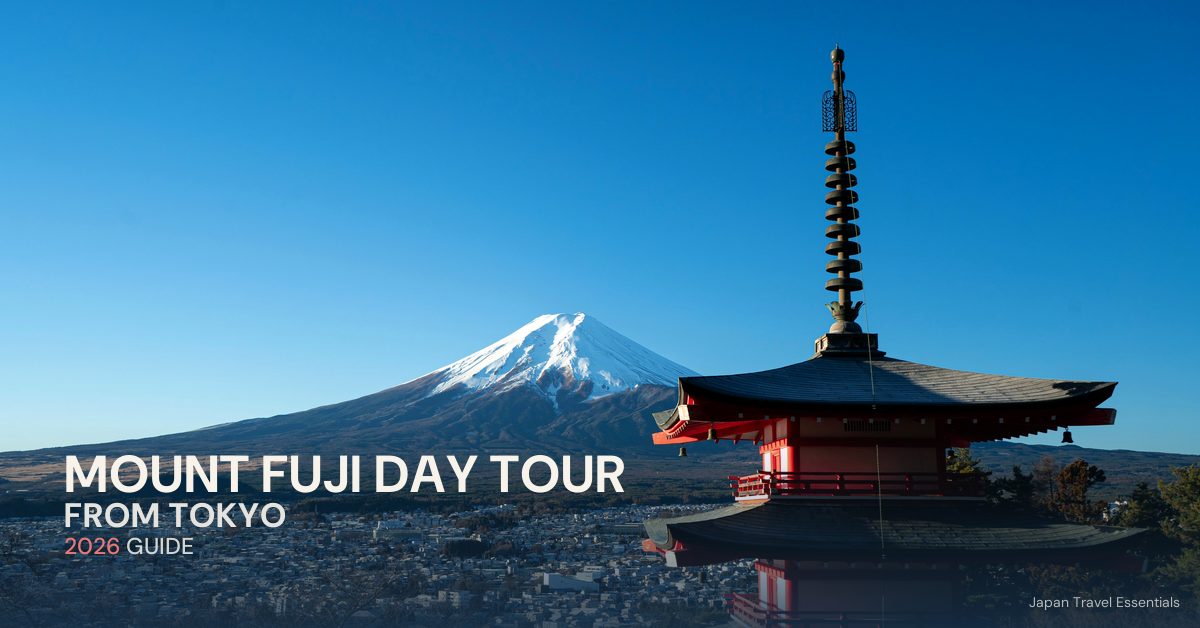
- Arakurayama Sengen Park (1 hour) — home to the viewpoint most people recognize from photos: Mt. Fuji framed by a five-story pagoda
- Arakura Fuji Sengen Shrine (15 min) — the shrine at the base of that same park
- Fujiyoshida Retro Shopping Street (15 min) — a nostalgic shopping street near the end of the route
- Lake Yamanaka (25 min) — also known as “Swan Lake,” this is the largest of the Fuji Five Lakes and one of the closest to the mountain itself
That’s a genuinely full day of movement — short stops at some spots, a full hour at others. It’s built for seeing a lot of ground, not lingering for hours at any one place.
Viator’s own summary text still describes “eight” viewing points, while the detailed itinerary on the same listing shows nine stops including Lake Yamanaka — we’ve gone with the more detailed, stop-by-stop itinerary as the source of truth.
What’s Included
- Air-conditioned vehicle for the full route
- All fees and taxes
What’s Not Included
- Lunch
- Personal expenses (souvenirs, snacks, admission to anything optional along the way)
Bring cash or a card for food. None of the admission fees at the listed stops carry an extra charge based on the current listing, but budget for a meal and drinks across a 10-hour day.
Who This Tour Is Best For
- Solo travelers and couples who don’t want to coordinate their own transport
- First-time visitors to Japan who’d rather not navigate bus timetables in a second language
- Budget-conscious travelers who want the Fuji Five Lakes highlights without paying private-tour prices
- Anyone who wants a fixed, no-planning day: get picked up, get dropped off, done
Who Should Consider Another Option
- Travelers who want a private vehicle and a flexible, personalized route — look at a private Mt. Fuji tour instead, even though it costs more per person
- Anyone using a wheelchair — the listing specifies the tour is not wheelchair accessible
- Travelers managing serious heart conditions or similar medical concerns — the listing flags this directly
- People who dislike group settings or fixed timing at each stop
- Anyone hoping to add Hakone to the same day — this itinerary stays within the Fuji Five Lakes area and doesn’t cover Hakone
Mount Fuji Tour vs. DIY Day Trip
Doing it yourself isn’t complicated, but it’s not effortless either. From Shinjuku, you’d take either the Fuji Excursion limited express (around 1.5 hours, reserved seats) or a highway bus (roughly 2 to 2.5 hours, generally the cheaper option). From Kawaguchiko Station, a local sightseeing bus loop covers most of the same viewpoints this tour visits — a rechargeable IC card makes paying for these local buses much simpler than counting exact change. Check current schedules and fares directly with the train and bus operators before you plan around them — timetables and reservation rules can change.
Where DIY wins: More control over timing, and it can come out cheaper if you’re comfortable planning your own route and don’t mind figuring out bus schedules on the day.
Where the tour wins: Zero planning, one price, one pickup, and someone else handling the return leg — which matters more than people expect after a long day of walking.
If reading a transit map the night before your trip sounds like part of the fun, DIY suits you. If you’d rather book once and show up, this tour removes that entire step.
What to Expect During the Day
Expect an early departure from central Tokyo and a return in the evening — this is a full 10-hour day, not a half-day add-on. You’ll be moving between stops on the bus for a meaningful chunk of that time, with the longest stays (about an hour each) at Oshino Hakkai and Arakurayama Sengen Park.
The pace is efficient rather than relaxed. You’re covering eight stops in one day, so plan for short windows at some of them — enough time for photos and a quick look around, not a leisurely afternoon.
Best Time of Year for a Mount Fuji Day Trip
Fuji doesn’t show up on demand — cloud cover matters more than the calendar, but the calendar still shifts your odds. Winter (December through February) tends to offer the clearest, driest air and the best visibility overall. Late autumn, especially November, pairs decent visibility with autumn color around the lakes.
Spring brings cherry blossoms but also a period of seasonal haze in April, when dust and particulates can drift in and soften the view. Summer (June through August) is the toughest season for visibility — it’s Japan’s rainy season, and humidity keeps clouds parked around the peak more often than not.
Early morning generally beats midday for a clear view, in any season.
Weather and Mount Fuji Visibility
Be honest with yourself about this before you book: no tour, including this one, can guarantee you’ll see the mountain. Fuji is famous for hiding behind cloud even on days that look clear from Tokyo. It can also appear unexpectedly on a day the forecast called for haze.
That’s exactly why the free cancellation window matters here — up to 24 hours before departure, you can cancel and shift to another date if the forecast looks bad. It won’t refund a day where clouds rolled in after you’d already committed, but it does let you dodge an obviously poor-visibility day in advance.
What to Wear and Bring
- Comfortable, closed-toe walking shoes — you’ll be on your feet at multiple stops, including some uneven ground near Oshino Hakkai and stairs around Arakura Fuji Sengen Shrine
- Layers, especially outside summer — the Fuji Five Lakes area sits at higher elevation than Tokyo and runs noticeably cooler
- Cash in yen for food and any souvenirs, since lunch isn’t included
- A charged phone or camera — several stops (the Lawson photo spot especially) are built around a single good shot
- Sun protection in summer, given the amount of time outdoors between stops
Tips Before Booking
- This listing tends to book out further ahead than a last-minute decision allows — bookings here average around 39 days in advance, so don’t wait until the week of your trip if you have a specific date in mind
- Double-check the meeting point assigned to your booking before travel day — there are two pickup options, and they’re confirmed at checkout, not fixed in the listing itself
- Free cancellation runs up to 24 hours before departure, so it’s worth booking early and adjusting later if your itinerary shifts
- Confirm the current price on the page before paying — this listing has run limited-time discounts on and off, so the number you see may differ from what we recorded
- Have a Japan eSIM or mobile data plan sorted before you go — you’ll want maps and translation working smoothly once you’re out past Kawaguchiko, away from Tokyo’s denser coverage
Is This Mount Fuji Tour Worth It?
For the price of one shared bus seat, you get a full day covering eight recognizable Fuji Five Lakes viewpoints, transport handled start to finish, and a cancellation policy that gives you room to dodge a bad-weather forecast. Compared to piecing together trains and local buses yourself, that’s a reasonable trade — especially on a first trip to Japan, when you’d rather not spend planning time on logistics.
It’s not the pick if you want a private vehicle, a slower pace, or Hakone folded into the same day. For everyone else weighing “tour or DIY,” this is a solid, well-reviewed way to see Fuji without organizing it yourself.
Check Availability on Viator →
How to Book
Availability and pricing are shown live on the Viator listing once you select a date and traveler count. Reserve Now and Pay Later is available on this listing, meaning you can hold your spot without paying immediately — useful if your Japan itinerary is still taking shape.
FAQ
Is a Mount Fuji day trip from Tokyo actually worth it?
For most first-time visitors, yes — you cover several of the area’s best-known viewpoints in one day without arranging your own transport. Just go in knowing it’s a full, moving-around kind of day, not a relaxed one.
Is this a private tour?
No. This is a shared group bus tour. If you specifically want a private vehicle and a flexible route, look at a private Mt. Fuji tour instead — it costs more, but it’s just your group.
What if it’s cloudy or rainy on my tour date?
The tour may still operate in cloudy or rainy weather, although the itinerary can be affected by weather, traffic, or operating conditions. Even if every stop runs as planned, you may not get a clear view of the mountain itself. Free cancellation up to 24 hours out gives you a way to shift your date if the forecast looks bad.
Does this tour include lunch?
No. Budget separately for food — there are food stalls and shops at several stops, including Oshino Hakkai.
How far in advance should I book?
Bookings for this listing average about 39 days ahead. If you have a fixed date, booking a month or more out is a reasonable target.
Does this tour also visit Hakone?
No. This itinerary stays within the Fuji Five Lakes area. If you want Fuji and Hakone in a single day, that’s a different product.
Final Verdict
If you want the Fuji Five Lakes highlights without renting a private car or building your own transit plan, this is a straightforward, well-reviewed way to do it. It’s a full day, it’s a shared bus, and it won’t guarantee clear skies — but it handles the one thing that trips up most first-time visitors: getting there and back without the logistics.